Showing posts with label Impact studies. Show all posts

Wednesday, April 3, 2019

Rapid growth in extraction of materials is the chief culprit in climate change and biodiversity loss


  • Resource extraction has more than tripled since 1970, including a fivefold increase in the use of non-metallic minerals and a 45 per cent increase in fossil fuel use

  • By 2060, global material use could double to 190 billion tonnes (from 92 billion), while greenhouse gas emissions could increase by 43 per cent

  • The extraction and processing of materials, fuels and food contribute half of total global greenhouse gas emissions and over 90 per cent of biodiversity loss and water stress
Rapid growth in extraction of materials is the chief culprit in climate change and biodiversity loss – a challenge that will only worsen unless the world urgently undertakes a systemic reform of resource use, according to a report released at the UN Environment Assembly.

Global Resources Outlook 2019, prepared by the International Resource Panel, examines the trends in natural resources and their corresponding consumption patterns since the 1970s to support policymakers in strategic decision-making and transitioning to a sustainable economy.

Over the past five decades, the population has doubled and global domestic product has increased four times. The report finds that, in the same period, annual global extraction of materials grew from 27 billion tonnes to 92 billion tonnes (by 2017). This will double again by 2060 on current trends.
According to the report, “the extraction and processing of materials, fuels and food make up about half of total global greenhouse gas emissions and more than 90 per cent of biodiversity loss and water stress”. By 2010, land-use changes had caused a loss of global species of approximately 11 per cent.

“The Global Resources Outlook shows that we are ploughing through this planet’s finite resources as if there is no tomorrow, causing climate change and biodiversity loss along the way,” said Joyce Msuya, Acting Executive Director of UN Environment. “Frankly, there will be no tomorrow for many people unless we stop.”

Since 2000, growth in extraction rates have accelerated to 3.2 per cent per annum, driven largely by major investments in infrastructure and higher material living standards in developing and transitioning countries, especially in Asia. However, the wealthiest countries still needed 9.8 tons of materials per person in 2017, mobilized from elsewhere in the world, which is also driving this trend.

More specifically, the use of metal ores increased by 2.7 per cent annually and the associated impacts on human health and climate change doubled during 2000-2015. Fossil fuel usage went from 6 billion tonnes in 1970 to 15 billion tons in 2017. Biomass increased from 9 billion tonnes to 24 billion tonnes – mostly for food, feedstock and energy.

By using data from historical trends, the report projects into the year 2060. From 2015-2060, natural resource use is expected to grow by 110 per cent, leading to a reduction of forests by over 10 per cent and a reduction of other habitats like grasslands by around 20 per cent. The implications for climate change are severe, as there would be an increase in greenhouse gas emissions of 43 per cent.
The report says that if economic and consumption growth continue at current rates, far greater efforts will be required to ensure positive economic growth does not cause negative environmental impacts.

The report argues that resource efficiency is essential, though not enough on its own. “What is needed is a move from linear to circular flows through a combination of extended product life cycles, intelligent product design and standardization and reuse, recycling and remanufacturing,” it says.

If the recommended measures are implemented, it could accelerate economic growth, outweighing the up-front economic costs of shifting to economic models consistent with holding global warming to 1.5°C this century.

“Modelling undertaken by the International Resource Panel shows that with the right resource efficiency and sustainable consumption and production policies in place, by 2060 growth in global resource use can slow by 25 per cent, global domestic product could grow 8 per cent – especially for low- and middle-income nations – and greenhouse gas emissions could be cut by 90 per cent compared with projections for continuing along historical trends,” the Co-Chairs of the Panel, Izabella Teixeira and Janez Potočnik, wrote in the joint preface to the report.

Wednesday, October 31, 2018

Sustainability certification initiatives need to be more effective

New SOMO research shows that working conditions on many certified farms and plantations are still problematic. Workers face an array of challenges including poor pay, unsafe and unhealthy situations, and they are prevented from standing up for their rights. 

Changes and improvements are urgently needed for ambitious sustainability certification initiatives to become a significant instrument in improving working conditions for farm workers across the developing world.

Sunday, March 5, 2017

Evaluation report on the UTZ tea program in Sri Lanka

From utz.org
"This study, commissionned by UTZ, evaluated the social, economic and environmental outcomes of the UTZ tea program in Sri Lanka. The researchers took a qualitative approach, combining different research methods. They assessed the UTZ program within the local context, from the perspective of different stakeholders, and also looked for unexpected changes."

Download the report

Friday, June 3, 2016

Study: The Dark Side of Chocolate

An analysis of the conventional, sustainable and fair trade cocoa chains.
By BASIC (Bureau for the Appraisal of Societal Impacts and Costs), for the French Fair trade Platform.

"Based on the available studies, Basic's analysis shows that there are at least two necessary conditions for kickstarting virtuous circles for producers and their communities:
• A sufficiently solid cooperative dynamic that is rooted in the communities and supported by the members;
• A price that is sufficient to allow producers to meet the needs of their families, and a collective premium that is sufficient to strengthen the cooperative and allow it to invest in local services.

However, the positive effects documented in these ‘virtuous’ cases may be jeopardised in the long term by the diminishment of forest resources, the main – or even only – alternative being to introduce agroforestry practices."

Monday, March 30, 2015

Fairtrade Monitoring and Impact, 2014

"This General Overview lists facts and figures on Fairtrade's impact for more than 1.5 million farmers and workers in 74 countries around the world."

Read further 

Thursday, March 5, 2015

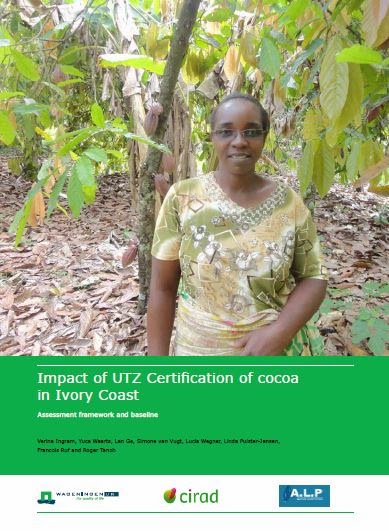
Impact of UTZ Certification of cocoa in Ivory Coast Assessment framework and baseline

In 2012, UTZ Certified commissioned LEI Wageningen UR to determine the effects of this certification programme. LEI Wageningen UR led the study in partnership with the Centre for Development Innovation (CDI Wageningen UR), the French Centre de Coopération Internationale et Recherche Agronomique pour le Développement (CIRAD), and Ivorian research organisation Agriculture et Cycles de Vie (A.C.V). 

This report presents the results of the independent baseline survey and assessment framework by the research team. It evaluates the effectiveness of cocoa programme in bringing about improvements for cocoa farmers and cooperatives participating in the programme. Based on this evaluation, the report draws lessons learned and provides recommendations to improve the quality of the programme. 

Authors : Verina Ingram, Yuca Waarts, Lan Ge, Simone van Vugt, Lucia Wegner, Linda Puister-Jansen, Francois Ruf, Roger Tanoh 

June 2014.

Wednesday, October 22, 2014

Fair wages for farm labourers?

Consumers relate fair trade to products of ‘small farmers’ who work in cooperatives. This image is not really correct because already in 1994 a first large tea plantation became fair trade certified. Twenty years later fair trade labels source bananas, tea, flowers and wine from large farm businesses, while the debate whether this is the way to go is still raging. Central to the debate is the living wage concept, a fair wage for all workers – including seasonal workers.

Wednesday, May 28, 2014

Research finds Fairtrade fails the poorest workers in Ethiopia and Uganda

Fairtrade certified coffee, tea and flowers do not improve lives of the very poorest rural people in Ethiopia and Uganda, according to a four-year research project conducted by leading development economists at SOAS, University of London. The project studied rural labour markets in areas producing crops for export, under different institutional conditions that included, in some research sites, Fairtrade certification.

More information and download the report


Fairtrade International's comments on the report


Response to SOAS report: Fairtrade Foundation, UK

The Impacts of Fair Trade Certification: Evidence From Coffee Producers in Costa Rica - Harvard University

The authors of the study estimate the effects of Fair Trade (FT) certification on coffee producers in Costa Rica. They begin by examining a panel of all coffee producers between 1999 and 2010. They find that FT certification is associated with higher export prices equal to approximately 5 cents per pound. They find no evidence that certification is associated with more sales (either domestic or for export) or with higher domestic prices. Linking the mill-level information on FT certification to individual-level survey data, the authors find that FT certification does increase incomes, but only for skilled coffee growers and farm owners. According to them, there is no evidence that many workers, including unskilled seasonal coffee pickers, benefit from certification.

Nunn N, Dragusanu R. The Impacts of Fair Trade Certification: Evidence From Coffee Producers in Costa Rica. 2014.


Wednesday, December 19, 2012

Study Confirms Positive Effects of Fairtrade on Rural Development

What are the effects of Fairtrade on rural development in the producing countries of the South? Which are the decisive factors for an ideal influence? On the occasion of its 20th anniversary, TransFair e.V. Germany and Max Havelaar Switzerland commissioned a study that assesses the effects of Fairtrade in several product ranges on three continents. “The latest results show that Fairtrade creates an improved income and contributes to poverty reduction in rural areas,” said Dieter Overath, General Manager of TransFair. “In regions with strong Fairtrade representation, such as banana farming in Peru or rose cultivation in Kenya, conventional farmers have even started copying Fairtrade standards, for example when it comes to paying a premium or improving their working conditions.” The study was co-financed by the Swiss State Secretariat for Economic Affairs (SECO), the German development co-operation organisations Misereor and Brot für die Welt/EED and was developed by research institute CEval of Saarbrücken, Germany.
Surveys Across Six Product Ranges in Africa, Latin America and Asia
A range of qualitative and quantitative data was gathered for this study. Farmers and dependent workers of four countries were interviewed in 32 group discussions and 128 individual interviews. 3750 survey forms as well as primary and secondary literature were evaluated. The methodically ambitious implementation of this study allows making clear statements on the effects of Fairtrade on rural development. Case studies from the coffee, banana, tea, cotton, cocoa and flower product ranges were evaluated. The team at CEval compared the development of Fairtrade-certified small farmer co-operatives, plantations and contract production with that of conventional organisations. Comparative parameters included education, health care and gender.
Improved Socio-Economic Situation
The study proves that small farmers and workers on Fairtrade-certified co-operatives and plantations have a slightly higher and more stable income available. Approximately 64 per cent of the respondents reported being able to save some money, compared with 51 per cent of the comparison group. The productivity of the certified organisations was also increased in most cases. 85 per cent of all respondents in the cotton case study reported an improved access to credit. Almost 85 per cent of the workers at the investigated Fairtrade-certified flower plantations have a permanent contract of employment, as opposed to fewer than 20 per cent in the compared conventional plantations. The sometimes massive investments in the local infrastructure, such as road improvements, have a major impact on rural areas. A general improvement in the education and healthcare sectors is an indirect consequence of this.

The Population is Involved in Development Activities
CEval found out that money from Fairtrade Premiums was often invested in projects that benefitted the residents of a whole region. The fact that small farmers and workers can implement development projects independently means that these projects are accepted and supported by the general public. A more powerful organisation and positioning of small farmers in co-operatives have even led to the break-up of existing power constellations in some cases. In plantations, the independent administration of the Fairtrade Premium by a committee of elected worker and management representatives, the so-called Joint Body, has enabled workers to assume responsibility in decision-making processes – a unique situation.

Optimization of Effects through a Committed Management and Increased Access to Markets
The effect of Fairtrade on rural development largely depends on Fairtrade sales, on how well the producers and management are informed and organised and on how serious they are in their commitment to Fairtrade. CEval recommends that the functioning “best practice examples” should be used to increase the efficiency within the Fairtrade system.

Wednesday, November 14, 2012

Fair Trade: Study shows some companies are better at playing fair

Companies using the Fairtrade Mark demonstrate different types of commitment to the fair trade movement and therefore their impact on producers in developing countries is not the same, according to a new review from the University of York.
The report identifies seven categories, or ‘value chains’ for Fairtrade, assessing products from production through to their sale to consumers. They range from products that are 100 per cent Fairtrade that are produced, supplied and retailed by Fair Trade Organisations, to major brands converting products to be Fairtrade certified for general sale by multinational corporations such as Procter & Gamble and Cadburys.

This paper critically examines the discourse surrounding fair trade mainstreaming, and discusses the potential avenues for the future of the social movement. The paper highlights a number of benefits of mainstreaming, not least the continued growth of the global fair trade market (tipped to top $7bn in 2012). However, the paper also highlights the negative consequences of mainstreaming on the long-term viability of fair trade as a credible ethical standard.